

Market fluctuations are part of trading. A big down day followed by a bounce, like we saw last Friday and Monday, is nothing unusual. As traders, we must remember: volatility happens. The key is understanding how to handle these movements — not reacting emotionally but positioning strategically.
Click here or in the video below to explore more.
Subscribe: YouTube
Subscribe: Soundcloud
The Hidden Risk in Flat Delta Trading Strategies
Many traders believe entering the market flat Delta makes their position “safe.” It feels neutral, balanced, and risk-managed. But as John Locke explains, this mindset hides a dangerous misconception.
When you enter a flat Delta position and the market moves up, you begin taking on downside risk — often unknowingly. This happens because:
- Your strategy adjusts to remain “neutral” as prices rise.
- Those adjustments often expose you to losses if the market reverses.
- You’re now taking downside risk after the market has already gone up.
This means you’re at a higher probability of loss than if you’d taken a bullish stance earlier.
Why a Bullish Position Can Be Smarter
A bullish position — like a bullish vertical — might seem riskier upfront. You can see where you might lose if the market dips. However, this transparency is a strength, not a weakness. You’re choosing your risk consciously, rather than hiding from it.
Here’s the key insight:
It’s often safer to take on downside risk before the market goes up, not after.
Why? Because markets move in cycles — up and down. When the market has already fallen, the probability of a rebound is higher. Entering a bullish vertical trade in that moment positions you for the likely upswing, rather than being caught reacting to it.
The Psychology of “Safe” Trades
Newer traders often fall into a trap. They choose “neutral” or “flat Delta” positions thinking they’ve avoided risk — but all they’ve done is disguise it.
Every trade has a losing scenario. The goal isn’t to eliminate it (you can’t), but to understand where it lies. When you know your losing scenario, you can make more intelligent entry decisions based on market conditions.
For example:
- Market has been down a lot → Favor a bullish vertical.
- Market has been up sharply → Be cautious about adding downside exposure.
Example: The Friday–Monday Bounce
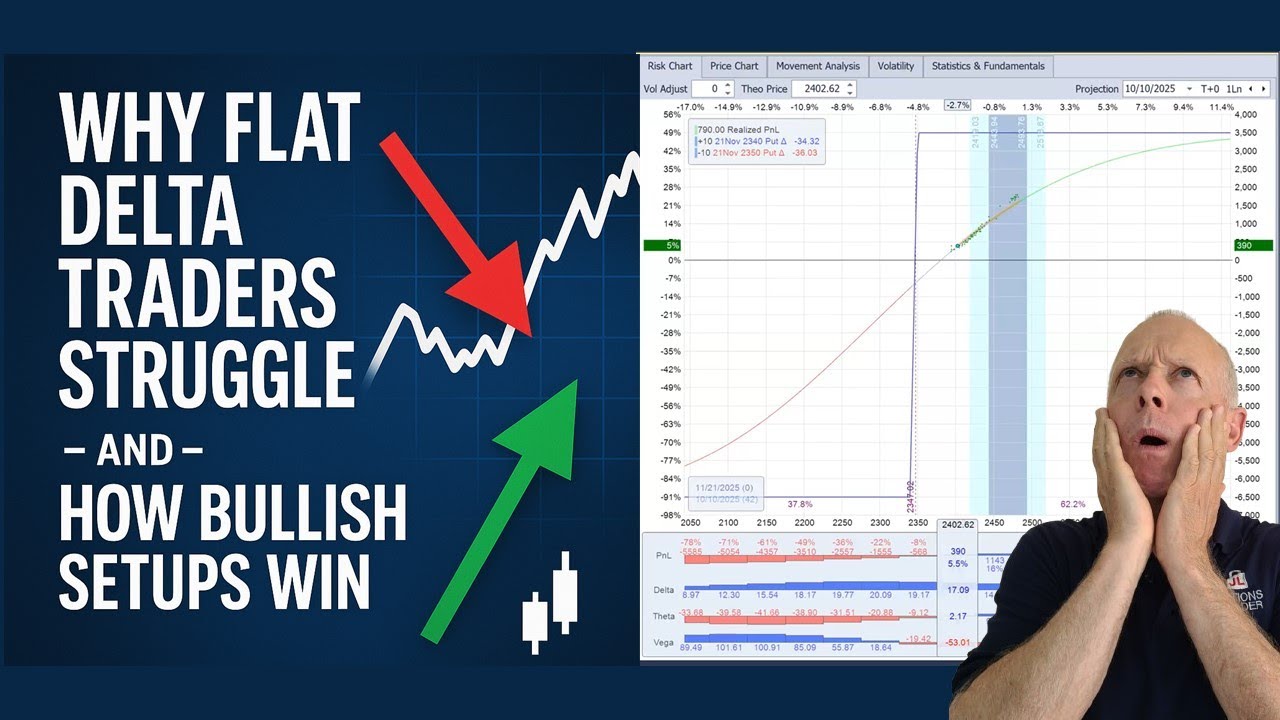
John Locke illustrates this with a practical example. On Friday, the market dropped sharply. Yet, the bullish trade wasn’t hurt — in fact, it maintained its maximum profit potential. Flat Delta traders, however, were likely forced to adjust downward during a P/L draw down, increasing their risk of losing or barely squeaking out a profit with a normal market reversal.
Key Takeaway: Trade Smart, Not Hard
There are easy ways to trade and hard ways to trade. The difference often lies in understanding your position’s dynamics:
- Flat Delta doesn’t mean no risk.
- Bullish positions, entered intelligently, can be less stressful and more profitable.
- Trading probabilities are not just about Delta numbers — they’re about understanding market behavior and timing.
Conclusion: Master the Market by Mastering Yourself
Becoming a great trader means developing awareness — not just of the market, but of your own decision-making. Recognize when your “neutral” strategies are quietly adding risk, and learn to position proactively instead of reactively.
Once you understand these dynamics, you’ll trade with more confidence, clarity, and consistency — the true mark of a professional trader.












Leave a Reply
You must be logged in to post a comment.