

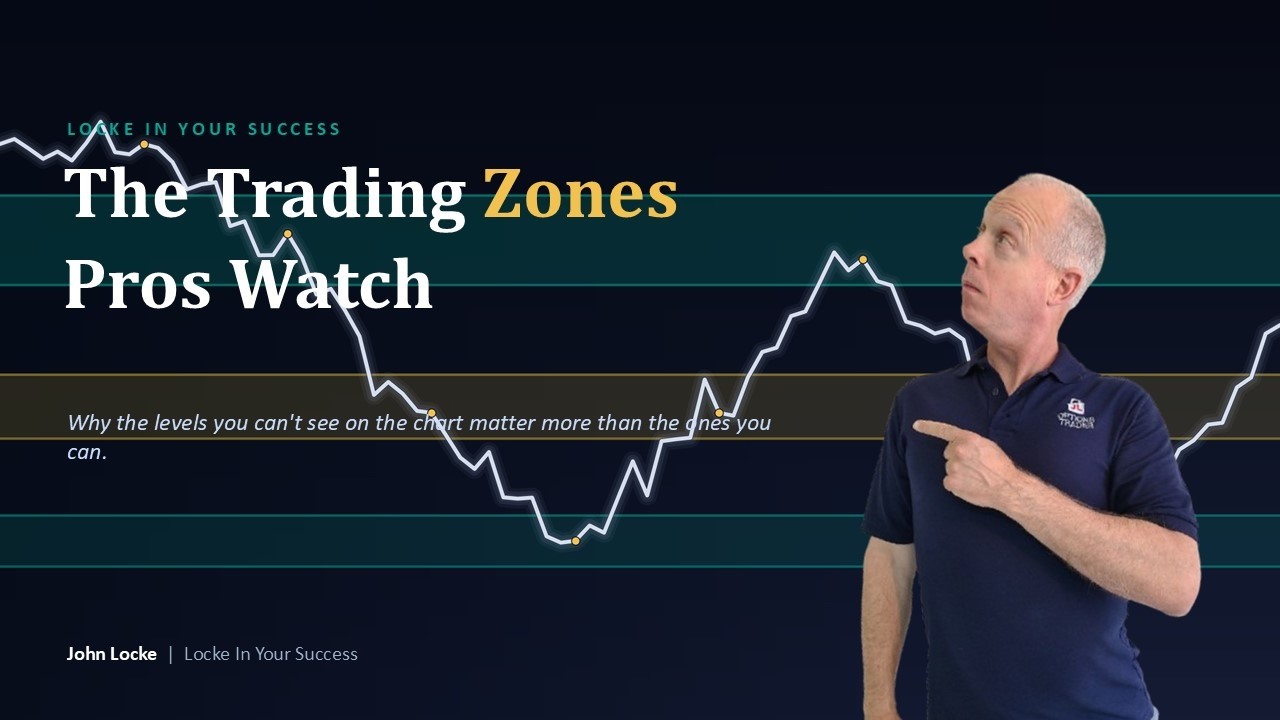
If you’ve ever pulled up a two-minute chart and felt like the market was lying to you, you’re not imagining things. Understanding trading zones — not just candles — is often the difference between reacting to every wiggle in price, and trading with real conviction. Below, we break down why timeframe changes everything, and why trading zones matter more than whatever your shortest chart is screaming at you right now.
Click here or on the video below to learn more!
Subscribe: YouTube
Why Trading Zones Matter More Than Any Single Candle
It’s fairly easy to predict price movement on longer-term charts and in wider price ranges. As you move into shorter and shorter timeframes, that prediction gets exponentially harder — not because the shorter timeframe is inherently more complex, but because you’re forced to change your opinion far more often. This is one of the core ideas behind sound technical analysis: price action means something different depending on the lens you’re viewing it through.
On a weekly chart, your read on the market really only changes once a week. Intrabar candles don’t mean much; you update your opinion as new weekly information hits the market. Drop down to a two-minute chart, though, and your opinion might shift every two-minute bar — or even mid-bar, based on nothing more than 30-second or 15-second price action. That’s the core challenge of trading shorter timeframes: it’s not difficulty, it’s frequency. You have to be willing to flip your bias, sometimes several times, in a single session.
Shorter Timeframes Mean More Reversals — And That’s Normal
When you’re working intraday, you’re going to violate your levels more often, and those violations are going to mean something. You might make a decision based on a level breaking, only to watch price violate right back the other way. When that happens, you need to reverse out of that decision immediately, because you now have new information.
This back-and-forth is a normal part of trading shorter timeframes, not a sign you’re doing something wrong. The traders who struggle are usually the ones who get married to a single read and refuse to update it. The traders who succeed treat every new bar as a fresh piece of evidence, weighed against the trading zones already established on the higher timeframes.
Longer-Term Trading Zones Always Carry More Weight
Here’s the part most short-term traders miss: longer-term pricing information is considered more relevant, and more powerful, than shorter-term pricing information. You might have a two-minute chart flashing a strong signal in one direction — but if the weekly chart shows you sitting inside a major trading zone, that longer-term context can easily override what the short-term chart is telling you.
This is exactly why understanding the trading zones you’re likely to trade in, is often far more valuable than obsessing over the smallest print on your screen. And the shorter your timeframe gets, the more of these longer-term zones you have to keep stacked in your head at once.
How to Actually Use This on Your Own Charts
Here’s how to put this into practice the next time you sit down to trade:
- Start from the highest timeframe you care about (weekly or daily) and mark the major trading zones first — before you ever zoom in.
- Treat shorter-timeframe signals as tactical entries within that zone, not as standalone decisions.
- Expect to change your mind more often as you drop to lower timeframes — that’s the cost of trading intraday, not a red flag.
- When a level violates and then violates back, reverse your decision quickly. New information beats old conviction.
- Never let a short-term chart argue you out of what the longer-term trading zones are telling you.
Final Thoughts: Trade the Zone, Not Just the Candle
The traders who consistently read charts well aren’t the ones with the fastest reaction time on a two-minute chart — they’re the ones who understand which trading zones they’re operating inside before they ever place a trade. Short-term price action will always be noisy, and you’ll always need to change your opinion more often the lower you go. But if you anchor every decision to the trading zones set by the higher timeframes, that noise becomes a lot easier to manage.
Want to see this concept applied live on a real chart? If you are a Pro or Market Outlook member log in to watch the full video breakdown for a step-by-step look at how trading zones and timeframes work together in real time, and check out more lessons like this one on the Locke In Your Success blog.













Leave a Reply
You must be logged in to post a comment.